
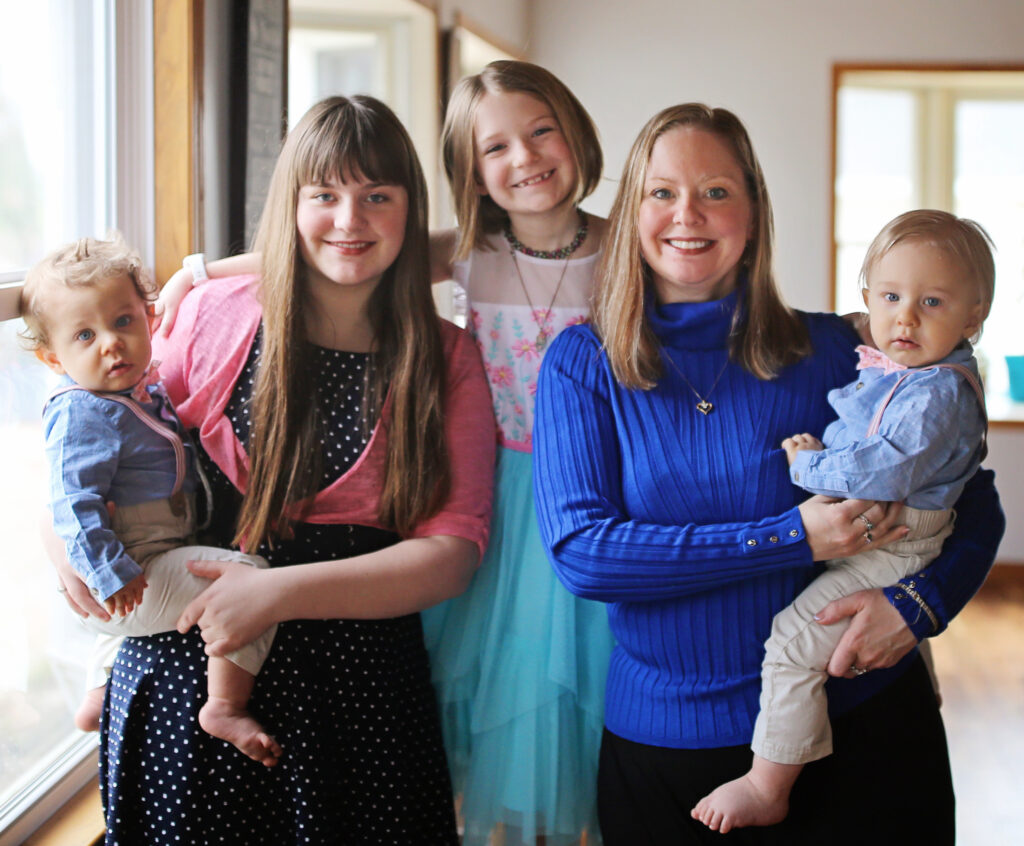
Blogger Margaret Gingrich, D.D.S., a general solo practitioner in Big Rapids, Michigan, has been involved in organized dentistry her entire career. She is the former president of the Michigan Dental Association and West Michigan District Dental Society. Dr. Gingrich is currently the 9th District representative on the ADA Council on Dental Practice and a member of the ADA House of Delegates. She is a 2004 graduate of the University of Michigan School of Dentistry and the co-chair of the Michigan Mission of Mercy, where she volunteers her time and craft to those in need. When she is not playing dentist or volunteering her services to the tripartite, Dr. Gingrich is a single mom of four children ages 14, 8 and two 15-month-olds.
I am a woman, a dentist, a delegate for the ADA, a chairperson for the Mission of Mercy, and I am a single mother of four. The juggling of these activities and the many other challenges that are a part of everyday life can be quite a struggle. It’s worse if you suffer from a mental illness.
I never thought I, myself, would be impacted by the mental health crisis. With the birth of my twin sons a little over a year ago, I found myself slipping into what some would call a “funk” in which I felt there was no way out. Being part of the medical profession, I was acutely aware that what I was facing had to be depression. The reality of my situation was concerning, if not downright terrifying. I was afraid of the ramifications that a mental illness diagnosis could bring.
There is an overwhelming stigma attached to the mental health spectrum. Some of these stigmas arise from our own upbringings and the way in which we have seen mental health issues in the past. However absurd my fears may have been to some, I was still afraid to mention or admit my own reality for fear it would affect my licensing or, at the very least, scare patients away. The fear that a diagnosis would mean my patients wouldn’t feel I was worthy of their trust any longer was as real as what was happening to my body and mind.
One recent study found that 1 in 7 women may experience postpartum depression in the year after giving birth. With about 4 million live births occurring annually in the United States, this equates to almost 600,000 postpartum depression diagnoses. This diagnosis does not discriminate and can happen to anyone regardless of race, location, social and professional status, or even gender. Recent studies have found that nearly 50% of men who have partners diagnosed with postpartum depression will go on to develop mental health issues of their own.
As much as I feared being one of those statistics, it was my new reality. It was my doctor who pointed out to me that there was help available. I didn’t ask for help; I was too afraid of what others would think of my ill-fated diagnosis. I am forever grateful my OB/GYN was attentive and understanding.
There are treatments and options available. The U.S. Food and Drug Administration recently approved the first oral treatment for postpartum depression. This opens the door to end the suffering of thousands of new mothers, not just those in the medical profession. While the “baby blues” are still a common experience many women will have in their lifetime, it is essential to watch for the signs of a more significant problem.
I have a strong message for those out there struggling with perinatal mental health issues. You need not suffer in silence. In fact, you don’t need to suffer at all. Help is available in many forms, whether you are looking for counseling or medicinal assistance. Not only are you safe, but your practice is safe as well. Get the help you need, and get on the road to living a happy, healthy life again. I did, and I am now a proud parent of four, free of the worries and stigmas of saying I need help.
Remember that we all carry emotional, mental or physical baggage. It’s OK and all together possible to put that suitcase down and walk away. Oh, and the stress of being a single mom, well, that just goes with the territory.
Dr. Gingrich is moderating an ADA webinar that will help dental professionals and their families understand perinatal and postpartum depression, identify the risk factors and learn when to seek professional intervention. Perinatal Mood & Anxiety Disorders: Supporting Dental Professionals, Teams and Families will take place from noon-1 p.m. CDT Aug. 22. For those unable to attend live, a recording of the webinar will be available about three weeks after the event date at ADA CE Online. Both the live and recorded versions are worth one continuing education credit.
Thank you for sharing your deeply personal journey, which resonates with the struggles many of us face in balancing professional commitments, family responsibilities, and our mental well-being. Your courage in discussing your experience with postpartum depression within the context of your roles as a dentist, delegate for the ADA, and a single mother of four is truly inspiring.
Hi,
Many of us can relate to the challenges you’ve described in juggling work, family, and mental health; your story has touched our hearts. As a dentist, ADA delegate, and single mother of four, it is incredibly admirable that you are willing to talk about your battle with postpartum depression.
It can be so hard to work as a dentist and be a new mother at the same time. We are pulled in so many different directions. Postpartum depression and postpartum anxiety are a struggle for so many. We have to remember, that over time (and when our children sleep through the night and become more independent, things do get better. That is, at least until the teenage years! Best of luck to all the new mother dentists out there.
This is such a deeply personal journey! Thank you for sharing. As our clinic has grown, I have noticed certain dentists and dental assistants burn out or deal with mental health issues. We work hard to identify when our professionals are having mental health issues or simply just need time to focus on their personal lives. Team building is one of the most important parts of keeping a cohesive team. We have started having more general team building trips and have started playing videos games together in our off hours (games that have teamwork in them). It has really helped keep our team tightly knit and made it easier for our professionals to open up to each other. It sometimes is hard to do this during the non-stop working day…but when you are connecting with your peers on a personal level, people start to open up.
Again, Thank you Dr. Gingrich for sharing your story! I hope you and your new family are healthy, happy, and have beautiful smiles!